
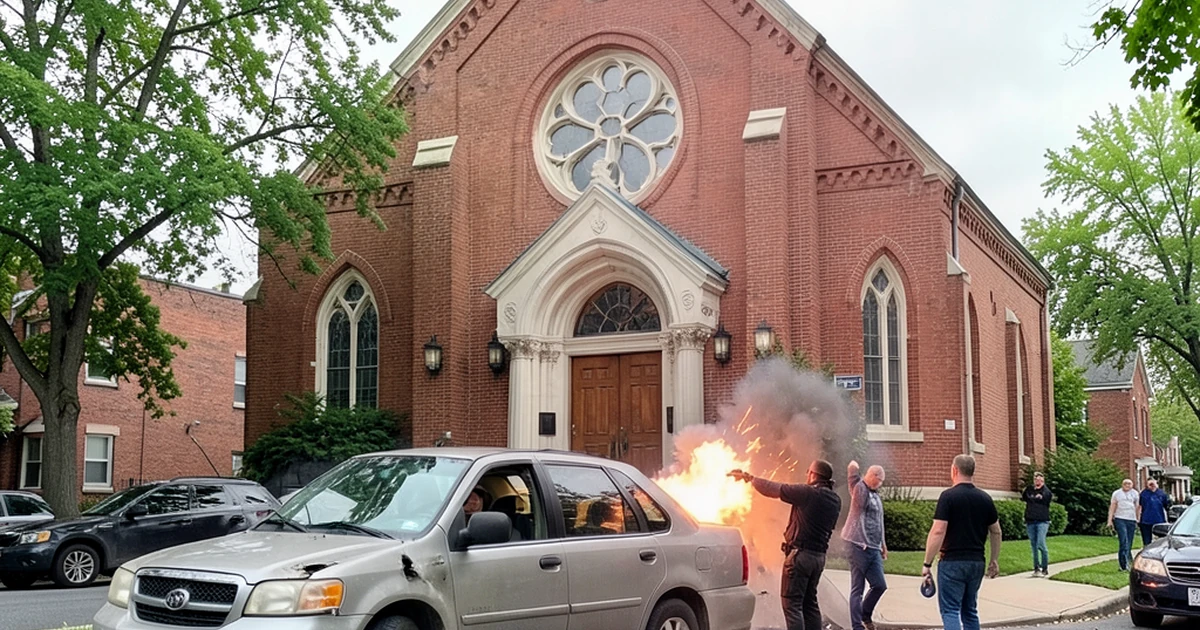
An assailant is dead after ramming a vehicle into the nation’s largest Reform synagogue and opening fire, an event that is shaking the community and raising urgent questions about the security of religious institutions. This attack in a quiet Detroit suburb forces a difficult conversation. It’s not just an isolated incident; it’s a symptom of a disturbing trend.
→ Watkins Header Secures Historic Villa Win in France
- The Attack: An armed man rammed his truck into the Temple Israel synagogue in West Bloomfield, Michigan, driving down a hallway before being engaged by security.
- The Outcome: The suspect was killed after a confrontation with synagogue security. A security guard was injured but is expected to recover. The suspect’s vehicle caught fire, and authorities are investigating possible explosives.
- The Reaction: The incident, described as an “active shooter situation,” has been condemned by officials, including Michigan’s governor, and has prompted lockdowns and increased patrols at other Jewish institutions.
- Watkins Header Secures Historic Villa Win in France
- Temple Security Halts West Bloomfield Synagogue Attack
- Evans’ Bold Leap: Redefining Veteran Legacies
- Jennifer Runyon: Celebrating a Screen Life
- Oil Prices: Navigating 2026’s Volatile Currents
For more discussion, see this discussion on Reddit.
What Exactly Happened at Temple Israel?
Thursday afternoon shattered the peace in West Bloomfield, Michigan. According to Oakland County Sheriff Michael Bouchard, a man intentionally drove his pickup truck through the front doors of the Temple Israel synagogue. He didn’t just stop at the entrance. He proceeded with “purpose” down a main hallway. That’s when the synagogue’s own security team stepped in. Two law enforcement sources told CBS News the suspect exited the vehicle with a rifle before being shot by security personnel.
The situation escalated quickly. A fire erupted from the suspect‘s vehicle, sending thick smoke billowing from the building and complicating the investigation. Authorities, including the FBI and ATF, descended on the scene. In a statement to the press, Sheriff Bouchard confirmed the suspect was deceased but could not immediately clarify the cause of death, noting the chaotic nature of the event. Investigators are now carefully clearing the burned vehicle for potential improvised explosive devices. The suspect‘s body was reportedly badly burned, making identification a challenge.
One security guard, who was struck by the vehicle and knocked unconscious, was hospitalized but is expected to make a full recovery. Miraculously, no one else from the synagogue’s community, which includes an early childhood learning center, was physically harmed. The children were safely evacuated to a nearby Jewish Community Center for reunification with their parents.
A Community on Edge
The response was immediate and widespread. Michigan Governor Gretchen Whitmer called the attack “heartbreaking,” stating, “Michigan’s Jewish community should be able to live and practice their faith in peace. Antisemitism and violence have no place in Michigan.” Her sentiment was echoed across social media, where community members expressed shock and fear. The Jewish Federation of Detroit quickly advised all local Jewish organizations to implement lockout protocols, allowing no one in or out of their buildings as a precaution.
This incident taps into a deep vein of anxiety. As noted in a recent opinion piece from The Jewish Observer, protests and targeted harassment are increasingly moving from public squares to the very entrances of synagogues across the country, creating an “atmosphere of menace.” Recent shootings at three Toronto-area synagogues in a single week have only amplified these fears, with community leaders there calling the attacks “acts of terror.” The attack on Temple Israel, which serves 12,000 members, is not just a local crime; it’s a national headline that validates the security concerns of Jewish communities everywhere.
The Contrarian Pivot: Security Is No Longer Optional
While conventional wisdom might view this as another tragic but isolated “lone wolf” attack, our data points to a different reality: This is the new, unfortunate normal. The fact that a synagogue—a house of worship and learning—requires its own armed security detail that successfully neutralized a threat speaks volumes. “Security did their job,” Sheriff Bouchard stated, a simple sentence that carries immense weight. The investment in robust security, once a topic of debate, proved its worth in the most visceral way possible.
Here’s the kicker. The conversation is no longer *if* religious institutions need security, but *how* extensive it must be. The attacker was stopped not by a public police patrol, but by the synagogue’s own line of defense. This shifts the burden directly onto congregations. In practical terms, this means smaller, less affluent synagogues face a daunting challenge: funding the necessary training, personnel, and infrastructure to protect their members. The “pain point” is the inequity of safety. Security is expensive, and the threat is universal.
A Pattern of Threats
This attack does not exist in a vacuum. It is grimly reminiscent of other violent assaults on Jewish houses of worship. The 2019 shooting at a synagogue in Halle, Germany, on Yom Kippur, where a gunman failed to breach a fortified door before killing two people nearby, serves as a chilling parallel. In that case, as in West Bloomfield, a physical barrier and determined defense prevented a much larger massacre. That attacker, a right-wing extremist, also live-streamed his assault, a tactic used to inspire copycat violence.
Authorities have not yet released a motive for the Michigan attacker, but the incident is being investigated within the context of rising antisemitism. According to Al Jazeera, a general alert had been issued for sensitive locations following recent geopolitical escalations, though no specific threat against Temple Israel was known. This speaks to the frustrating reality for law enforcement and communities: the threat is both pervasive and unpredictable.
The translation for your day-to-day is that the sanctity of these spaces is under assault, forcing a fundamental change in how communities gather. The days of unlocked doors are long gone. Today, synagogues are forced to operate like fortresses, a sad testament to the world we live in. That changes the whole dynamic.
Relevant posts
Visit themarketmail.com for more stories.